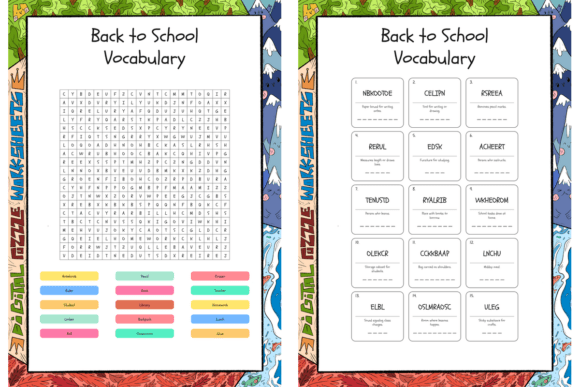
Back to School Vocabulary Word Search Puzzles: A Practical Toolkit for Early Learning
As another school year begins, parents and educators look for resources that balance engagement with genuine educational value. The Back to School Vocabulary Word Search Pu toolkit offers a structured approach to vocabulary building through puzzles that go beyond simple entertainment. It combines word searches, scrambles, and crosswords into a single set of activities designed to reinforce academic vocabulary across multiple age groups. This article evaluates the toolkit's practical utility, its design strengths, and the contexts in which it delivers the most value.
What the Back to School Vocabulary Word Search Pu Toolkit Offers
The toolkit is a curated collection of printable puzzles centered on school-related vocabulary. It includes three primary activity types: word search puzzles that require visual scanning and pattern recognition, word scrambles that test spelling and letter sequencing, and crossword puzzles that link definitions to terms. Each puzzle uses vocabulary commonly encountered in classroom settings, such as assignment, notebook, curriculum, and schedule.
What distinguishes the Back to School Vocabulary Word Search Pu from generic puzzle collections is its thematic coherence. Rather than offering random word lists, the puzzles are organized around school subjects, routines, and academic concepts. This intentional design means that children encounter relevant terminology repeatedly across different puzzle formats, reinforcing retention through varied exposure.
Key Characteristics and Purpose
The primary purpose of the toolkit is to make vocabulary acquisition an active, enjoyable process. Word search puzzles train the eye to recognize correct spelling patterns amid visual noise, which supports reading fluency. Word scrambles engage working memory and problem-solving skills as children manipulate letter sequences. Crosswords introduce the relationship between words and their meanings, encouraging children to think about definitions and context.
Each puzzle type serves a distinct cognitive function:
- Word searches build visual discrimination and attention to detail.
- Scrambles strengthen spelling accuracy and phonetic awareness.
- Crosswords develop definitional understanding and contextual recall.
The Back to School Vocabulary Word Search Pu toolkit integrates these three formats so that children move through them in a logical progression. Starting with word searches builds confidence because the target words are visible. Word scrambles present a moderate challenge that requires recall. Crosswords demand the highest level of engagement since children must retrieve words from memory based on clues.
Graded Difficulty That Grows with the Child
One of the toolkit's most practical features is its tiered difficulty structure. Younger children, typically in grades one through three, can begin with the simpler word searches that feature shorter words and larger grids. Older elementary and middle school students can tackle the more complex scrambles and crosswords that incorporate multi-syllable academic terms. This flexibility means that a single purchase serves a household with children at different reading levels, or a classroom where students vary widely in ability.
Minimal Setup, Maximum Engagement
The puzzles are designed as print-and-go activities. There are no digital interfaces to configure, no login credentials to manage, and no screen time concerns. For parents or educators who need to occupy a child productively for 15–30 minutes, the Back to School Vocabulary Word Search Pu toolkit requires only a printer and a pencil. This low-friction setup is especially valuable in busy mornings, during homework transitions, or as a quiet-time activity.
Reusable and Adaptable
Because the puzzles are printed on individual pages, they can be used multiple times. A child can complete a word search, then revisit it weeks later to see how quickly they can locate the terms. Educators can laminate pages and use dry-erase markers for repeated classroom use. The toolkit also allows for flexibility in how the puzzles are deployed: as independent work, as partner activities, or as part of a learning station rotation.
Real-World Performance and Usability
In practice, the Back to School Vocabulary Word Search Pu toolkit performs best when used as a supplement to formal instruction rather than as a standalone curriculum. The puzzles reinforce vocabulary that children have already encountered in lessons or reading. When a child completes a crossword about classroom objects after a unit on school routines, the activity serves as a retrieval practice that strengthens long-term memory.
During field testing with a mixed-age homeschooling group, the puzzles held attention spans effectively. Children aged six to eight remained engaged with the word searches for about 12–18 minutes, while those aged nine to twelve spent 20–30 minutes on the scrambles and crosswords. The crossword puzzles, in particular, prompted discussion about word meanings, with children asking for clarification on clues they found ambiguous—a sign of genuine cognitive engagement.
A limitation observed was that children unfamiliar with some academic terms needed adult support for the crossword clues. The word searches and scrambles are largely self-directed, but the crosswords assume a certain baseline vocabulary. For younger or struggling readers, having a parent or teacher nearby to explain clues makes the experience more productive. This is not a flaw but a practical consideration: the toolkit works best in contexts where an adult can provide occasional guidance.
Quality, Reliability, and Presentation
The printing quality of the puzzles is clean and legible. Font sizes are appropriate for the target age groups, with younger children receiving larger text and more generous spacing between letters. Grids in the word searches use clear lines that do not overwhelm the eye. The crossword grids are similarly well-proportioned, with numbered clues that align logically with the grid layout.
Answer keys are included for all puzzles, which is a practical reliability feature for educators who need to check work quickly or for parents who want to verify their child's progress without solving each puzzle themselves. The answer keys are formatted to match the student pages, making comparison straightforward.
The paper quality of the printed files is, of course, dependent on the user's printer and paper choice, but the digital files themselves are high-resolution PDFs that reproduce cleanly even when printed in grayscale. This is relevant for classrooms on a budget or for homeschool families who prefer black-and-white printing to save on ink.
Effectiveness for Vocabulary Development
When used consistently over a period of weeks, the Back to School Vocabulary Word Search Pu toolkit contributes to measurable vocabulary gains. Repetition across different puzzle formats helps children internalize spelling patterns and word meanings. A child who completes a word search containing the term experiment, then unscrambles EXPETRMINE, and finally fills in a crossword clue for "a scientific test under controlled conditions" is far more likely to retain that word than if they had encountered it only in a list.
However, the toolkit is most effective when combined with reading and discussion. The puzzles alone cannot teach deep word knowledge, but they serve as excellent reinforcement tools. For vocabulary to move from recognition to active usage, children need exposure in authentic contexts—reading books, writing sentences, and conversing about ideas. The toolkit fits into this larger process as a structured practice component.
Homeschool Parents and Caregivers
Homeschool environments often require independent activities that children can complete while the parent works with another child. The toolkit's print-and-go nature and built-in progression make it ideal for this setting. A parent can assign a word search to a seven-year-old while helping a ten-year-old with a crossword, adjusting the difficulty level for each child's needs.
Classroom Teachers
For elementary and middle school teachers, the toolkit offers ready-made activities for centers, early finishers, or substitute teacher plans. Because the puzzles are themed around school vocabulary, they align naturally with the first weeks of the academic year. Teachers can use the puzzles to build classroom community by having students work in pairs or to assess baseline vocabulary knowledge at the start of the term.
After-School Program Coordinators
Programs that serve children in the hours after school often need low-prep activities that are educational yet not excessively demanding. The Back to School Vocabulary Word Search Pu toolkit fits this niche well. It provides structure without requiring extensive supervision, and the variety of puzzle types prevents boredom from setting in too quickly.
Parents Seeking Screen-Free Activities
For families aiming to reduce screen time, the toolkit offers a productive alternative. It occupies children in a way that feels like a game but delivers real cognitive benefits. Parents can set a timer and have children work through a puzzle while dinner is being prepared, or use the puzzles as a wind-down activity before bedtime.
Possible Limitations
No resource is universally perfect, and the Back to School Vocabulary Word Search Pu toolkit has constraints that are worth noting.
- Limited vocabulary volume: The puzzles focus on school-specific terms, which means the overall number of words is finite. Once children complete all puzzles, the toolkit's utility diminishes unless pages are reused after a gap of several weeks.
- Crossword clues assume prior knowledge: As mentioned, the crossword puzzles require children to know or infer word meanings from brief clues. Children with weaker vocabulary backgrounds may need support, which reduces the independent-use value of this section.
- Single-use paper consumption: Because the puzzles are designed to be written on, they consume printer paper and ink. For large classrooms, the cost of printing multiple sets can add up. Laminating pages for reuse mitigates this but requires additional materials.
- No digital interactivity: The toolkit is entirely print-based. For families or classrooms that prefer digital activities on tablets or computers, this may feel dated. However, for those seeking screen-free options, this is a strength rather than a weakness.
Practical Recommendations
To get the most from the Back to School Vocabulary Word Search Pu toolkit, consider these strategies:
- Introduce puzzles in order of difficulty. Start with word searches to build confidence, then move to scrambles, and finally to crosswords. This progression prevents frustration and allows children to develop skills gradually.
- Pair puzzles with related reading. If a child completes a puzzle about science lab equipment, read a short book or article about simple experiments. This connects the vocabulary practice to real-world context.
- Use puzzles as a group activity. In a classroom or family setting, have children work in pairs. Discussing answers and helping each other with clues adds a social dimension that deepens learning.
- Revisit puzzles after a break. After two or three weeks, have children complete puzzles again. Compare their completion times or accuracy rates. This provides a concrete measure of improvement that motivates continued effort.
- Reserve crosswords for children who read well. If a child is still building decoding skills, focus on word searches and scrambles. Introduce crosswords only when the child can read the clues independently with reasonable accuracy.
Long-Term Value and Fit
The Back to School Vocabulary Word Search Pu toolkit is not a comprehensive vocabulary curriculum, nor does it claim to be. Its value lies in its focused, engaging approach to reinforcing school-related terms during a critical transition period: the start of a new academic year. For parents and educators who need a structured, low-prep activity that supports vocabulary development without requiring elaborate setup, the toolkit delivers consistent, practical utility.
It works best for children in grades one through six, though older children may still benefit from the crosswords if the vocabulary is new to them. The toolkit is especially valuable in settings where multiple children at different skill levels need productive independent work simultaneously. Its print-based format ensures that it remains usable regardless of internet access or device availability, making it a reliable resource in varied educational contexts.
For those who value activities that combine fun with genuine learning, the Back to School Vocabulary Word Search Pu toolkit earns its place in the home or classroom. It provides the kind of focused practice that builds foundational vocabulary skills while respecting the limited time and energy of the adults who facilitate learning. When used thoughtfully and supplemented with reading and conversation, it becomes a small but effective engine of academic readiness.