The Art and Engineering of Computer Graphics Card Hardware: Exploring GPU Design, Cooling, and Performance
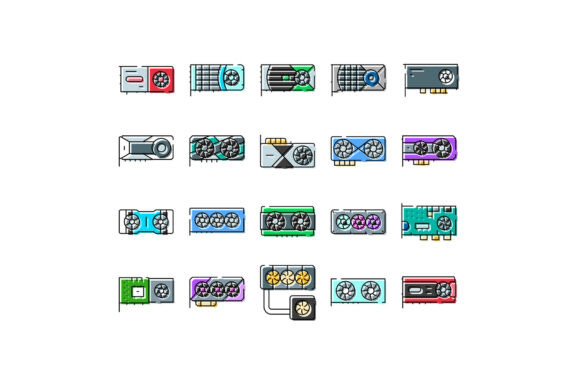
When you look inside a modern desktop computer, few components command attention quite like the graphics card. Its sculptural form, intricate circuitry, and prominent cooling fans make it a centerpiece of both performance and visual interest. This convergence of function and form is what we call Computer Graphics Card Hardware Line Art — the deliberate design language that defines how graphics processing units look, breathe, and perform. For gamers, video editors, and digital renderers, understanding this hardware is essential not just for building a system, but for making informed choices that directly impact workflow and enjoyment.
The graphics card has evolved far beyond a simple output device. Today, it is a specialized computer in its own right, housing its own memory, voltage regulation, and thermal management systems. The line art of its physical layout — the arrangement of VRAM modules, the positioning of power phases, the sweep of heat pipes across a die — is a map of engineering priorities. Each curve, fin, and fan blade tells a story about what the card was designed to accomplish.
Decoding the Visual Language of GPU Hardware
At first glance, a graphics card appears as a dense cluster of components mounted on a printed circuit board, often dominated by a large cooler assembly. But within that complexity lies a deliberate logic. The Computer Graphics Card Hardware Line Art is not accidental; it reflects thermal dynamics, electrical pathways, and mechanical constraints that engineers must balance.
Consider the GPU die itself, typically located at the center of the board. Surrounding it are memory modules — often eight or more chips — arranged in a pattern that minimizes trace lengths and signal interference. The power delivery system, usually located toward the rear of the card, consists of chokes, capacitors, and MOSFETs that filter and regulate electricity flowing to the core. This layout is not merely functional; it has become a recognizable visual signature that enthusiasts learn to read like a blueprint.
The cooling solution, whether a dual-fan, triple-fan, or blower-style design, is the most visually dominant element. Its fins, heat pipes, and shroud form the outer shell of the card, and its design directly influences both thermal performance and acoustic behavior. A well-designed cooler can mean the difference between a quiet, cool-running system and one that throttles under load or sounds like a small turbine.
The Role of Cooling Fans in GPU Performance and Longevity
Cooling fans are arguably the most visible and audible part of a graphics card. Their size, number, blade geometry, and bearing type all contribute to how effectively a card sheds heat. Modern GPUs often feature two or three fans, sometimes with one fan stopping entirely at low loads — a feature known as semi-passive or zero-RPM operation. This is a direct nod to user experience: silence when you are browsing the web, and full cooling when you are rendering a 4K video or exploring a dense open world.
Fan blade design has become a subtle art in itself. Some manufacturers use curved blades to reduce turbulence, while others employ a ring that connects the tips to prevent vibration at high speeds. These details may seem minor, but they accumulate into real-world benefits. A card that runs 5°C cooler under load can maintain higher boost clocks for longer, which translates directly into smoother frame rates and faster render times.
Dust accumulation is a practical consideration that many users overlook until their system starts running hot. Cards with easily accessible fans and removable shrouds are easier to clean, prolonging effective life. If you live in a dusty environment or have pets, choosing a card with a design that simplifies maintenance is a smart move. Some higher-end models even include dust-repellent coatings on the fan blades themselves.
GPU Designs for Gaming, Video Editing, and Digital Rendering
Not all graphics cards are created equal, and their physical design often hints at their intended workload. Gaming cards, for example, prioritize high clock speeds and responsive cooling for bursty loads. Video editing cards may emphasize larger memory pools and stable sustained performance. Digital rendering workstations often require cards with error-correcting code (ECC) memory and robust power delivery for hours of continuous computation.
The Computer Graphics Card Hardware Line Art of a gaming GPU is typically aggressive: angular shrouds, RGB lighting, and multiple large fans. These design cues are not purely cosmetic. The angular fins direct airflow more efficiently across heat sinks, and the lighting, while decorative, often serves as a quick visual indicator of load or temperature. For a gamer, this visual feedback can be both functional and immersive — a card that glows red under load fits naturally into a themed build.
For video editors, the priorities shift. Software like DaVinci Resolve or Adobe Premiere Pro benefits from large amounts of VRAM and efficient encoding hardware. A card designed for this workload will often feature a more subdued aesthetic but will include dedicated encoder chips and a cooler tuned for sustained loads rather than peak bursts. The line art here is cleaner, with fewer stylistic flourishes and more emphasis on thermal mass and airflow path.
Digital rendering — whether for architectural visualization, product design, or animation — places the highest demand on GPU stability. Rendering farms and individual workstations often use Nvidia RTX or AMD Radeon Pro cards that prioritize reliability over raw speed. These cards may have blower-style coolers that exhaust heat directly out of the case, making them ideal for multi-GPU configurations where internal airflow is limited. The line art of these cards is utilitarian, focused on function over flair.
Practical Considerations When Choosing a GPU
Before selecting a graphics card, it pays to think about your specific use case and how the hardware's design aligns with your needs. For gaming, consider the resolution and refresh rate of your monitor. A 1080p gamer may be perfectly served by a mid-range card with a dual-fan cooler, while a 4K enthusiast will need a flagship model with a triple-fan design and substantial VRAM. Pay attention to the card's length and thickness — many high-end cards are two or even three slots wide and may not fit in smaller cases.
For video editing, the amount of VRAM is often more important than raw core count. Editing 4K or 8K footage, especially with multiple layers and effects, can consume 8GB or more of memory. Look for cards with at least 12GB of VRAM if you work with high-resolution timelines. Additionally, check for hardware encoding support — Nvidia's NVENC and AMD's VCN can dramatically speed up export times.
Digital renderers should consider not only VRAM but also driver certification and software compatibility. Some rendering engines, like Octane or Redshift, favor Nvidia CUDA cores, while others are more agnostic. If you render professionally, the cost of downtime from an unstable card far outweighs the initial savings of a consumer-grade model. Workstation cards with ECC memory and validated drivers are worth the premium.
Observing the Evolution of GPU Hardware Line Art
Looking back at graphics cards from even a decade ago, the changes in physical design are striking. Coolers have grown larger and more sophisticated, backplates have become standard, and the materials used have shifted from basic aluminum to copper heat pipes, nickel-plated fins, and composite fans. The Computer Graphics Card Hardware Line Art has matured into a discipline that blends thermodynamics, acoustics, and industrial design.
One interesting trend is the rise of compact, high-performance cards that fit into smaller form-factor cases. Manufacturers now offer "mini" or "ITX" versions of popular GPUs that maintain strong performance while shrinking the physical footprint. These designs require innovative cooling solutions — often using a single larger fan with a specialized heat sink geometry — and demonstrate that line art must adapt to the constraints of space as much as to the demands of heat.
Another notable development is the increasing integration of RGB lighting and customizable aesthetics. While some purists prefer a clean, dark card without lights, many builders enjoy the ability to synchronize GPU lighting with other components. This has led to a proliferation of software-controlled LEDs that can indicate temperature, fan speed, or simply match a color scheme. The line art now includes lighting elements as integral design features, not afterthoughts.
Real-World Scenarios: Matching Hardware to Workflow
Consider a freelance video editor who works from a home office. Their typical project involves multicam 1080p editing with occasional 4K footage. A mid-range card with 12GB VRAM, a quiet triple-fan cooler, and hardware encoding support would serve them well. The ability to work without fan noise during client calls and to export quickly when deadlines loom are practical benefits that directly affect their productivity and professionalism.
For a competitive gamer who streams their gameplay, the requirements shift. They need a card that can maintain high frame rates at 1440p or 1080p while simultaneously encoding a stream. A model with a robust cooler to prevent thermal throttling during long sessions, and with dual encoders for smoother streaming, would be ideal. The visual design might also matter — a card with subtle RGB that matches their setup adds to the overall experience.
A digital artist working in 3D rendering software like Blender or Cinema 4D will value raw compute performance and memory bandwidth. They may render scenes with complex lighting and high polygon counts, which demands a card with many CUDA cores or Stream processors and ample VRAM. A workstation-grade card with a blower cooler might be chosen for a multi-GPU rig where space and airflow are limited.
Final Observations on GPU Hardware and Design
The physics of heat transfer, the constraints of electrical engineering, and the desires of users all converge in the physical form of a graphics card. The Computer Graphics Card Hardware Line Art is a visual and functional language that speaks to how a component will behave under load, how it will sound, how long it will last, and even how it will look inside a system. Paying attention to this design language helps you choose a card that not only performs well but also fits seamlessly into your workflow and your space.
Whether you are building a gaming rig, a video editing workstation, or a rendering machine, the graphics card is the heart of visual performance. Its fans, heat sinks, PCB layout, and shroud design all contribute to the experience. By learning to read the line art of GPU hardware, you gain the ability to select a component that meets your practical needs while also reflecting your personal standards of quality and aesthetics. In a world where digital creation and entertainment are increasingly central, understanding the hardware that powers them is not just useful — it is empowering.