Understanding Computer Graphics Processing Units Icons and Their Role in Modern Computing
When you work with hardware specifications, build a high-performance workstation, or explain GPU capabilities to a team, you quickly realize that a picture often communicates faster than a paragraph. Computer Graphics Processing Units Icons are the visual shorthand used across documentation, marketing materials, system dashboards, and educational content to represent GPUs and their roles in computing. These icons range from simple stylized chip diagrams to detailed illustrations that convey cooling solutions, form factors, and application focus areas. Whether you are a system integrator, a content creator, or an IT manager, understanding how to select, use, and interpret these icons can save time, reduce miscommunication, and improve the clarity of your technical materials.
What Computer Graphics Processing Units Icons Actually Represent
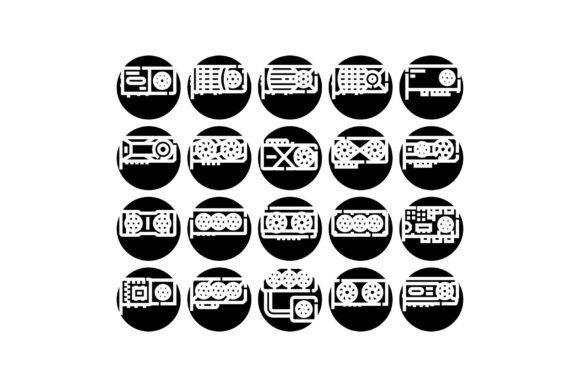
At a fundamental level, Computer Graphics Processing Units Icons serve as visual identifiers for the hardware that powers rendering, computation, and parallel processing tasks. A well-designed icon does not just show a generic microchip—it conveys the purpose of the GPU within a specific context. For example, an icon intended for gaming applications might emphasize cooling fans or RGB lighting, while an icon for blockchain mining could highlight multiple processing cores or a stacked architecture. The collection of these icons forms a visual vocabulary that helps professionals communicate GPU-related concepts quickly and accurately.
In practice, these icons appear in system monitoring software, technical documentation, presentation decks, e-commerce product pages, and even in educational diagrams explaining how parallel processing differs from sequential CPU tasks. The goal is always the same: reduce cognitive load by replacing lengthy descriptions with instantly recognizable symbols.
Common Challenges That Computer Graphics Processing Units Icons Help Solve
When you are managing a fleet of workstations for a rendering farm or advising clients on GPU selection for machine learning workflows, you face several recurring communication hurdles. First, technical specifications can overwhelm non-expert stakeholders. A list of core counts, memory bandwidth, and clock speeds means little to someone who simply needs to understand which system is suited for video editing versus scientific simulation. Computer Graphics Processing Units Icons bridge that gap by providing a visual context that anchors the technical data to a concrete use case.
Second, consistency in documentation suffers when teams use inconsistent imagery. One engineer might use a generic chip icon, while another uses a photographed card, and a third uses a 3D render. This inconsistency confuses readers and undermines professionalism. A dedicated collection of Computer Graphics Processing Units Icons ensures that every visual reference aligns with the intended message—whether that message is about raw compute power, thermal design, or form factor compatibility.
Third, cross-departmental collaboration often gets bogged down by jargon. Marketing teams need to promote GPU capabilities without sounding overly technical. Sales teams need to explain product tiers quickly. Support teams need to identify hardware at a glance during troubleshooting. Icons serve as a shared visual language that speeds up these interactions and reduces errors.
How Different Professionals Use GPU Icons to Meet Their Goals
The way you approach Computer Graphics Processing Units Icons depends heavily on your role and objectives. A system architect designing a high-performance computing cluster might use icons to visually map which GPUs handle simulation workloads versus which handle visualization. In this context, the icon needs to communicate thermal profile, power connector type, and physical dimensions—all at a glance. The same icon used in a marketing brochure would need to emphasize brand identity and performance positioning rather than technical fit.
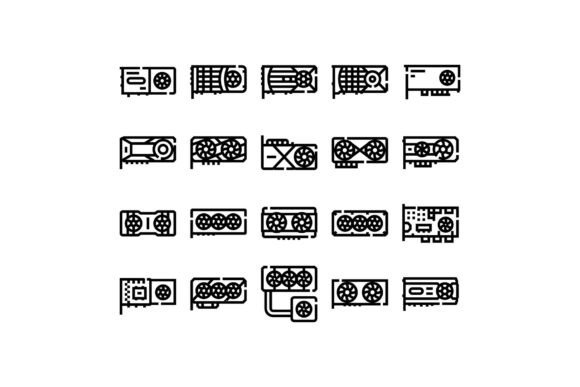
Content creators working with video editing or 3D rendering often use GPU icons in their system build guides and tutorial materials. For them, the icon must clearly distinguish between integrated graphics and discrete GPUs, and it should suggest the level of performance expected. A simple outline icon might work for a beginner-oriented guide, while a detailed icon with visible heatsinks and memory modules suits advanced hardware analysis.
Blockchain operators and cryptocurrency miners have specific needs when representing GPUs visually. Their collections of Computer Graphics Processing Units Icons often emphasize scalability—multiple cards arranged in a mining rig—and cooling solutions, since thermal management is a constant concern in that environment. Icons in this space tend to be more schematic, focusing on the arrangement of components rather than aesthetic detail.
Practical Applications Across Computing Disciplines
Let us explore how Computer Graphics Processing Units Icons translate into real-world outcomes across different domains.
High-Performance Computing (HPC): In HPC environments, GPUs handle parallel workloads like weather simulation, molecular modeling, and financial risk analysis. Icons used in cluster management dashboards help operators instantly identify which nodes are GPU-accelerated and which are CPU-only. A collection that includes distinct icons for different GPU generations—such as a specific symbol for Tensor Core-equipped units—enables quick visual auditing of hardware inventory. This reduces time spent reading text labels and minimizes configuration errors.
Gaming and Game Development: Game studios use GPU icons in their technical art documentation and performance optimization guides. Artists need to understand which GPU features—like ray tracing cores or variable rate shading—are available on target hardware. An icon collection that visually distinguishes these features helps developers make informed decisions about which graphical effects to implement. For gaming enthusiasts building custom PCs, icons in build guides simplify the process of matching motherboard PCIe slots with compatible GPU types.
Blockchain and Cryptocurrency Operations: Mining operations often involve racks of identical GPUs running at high utilization. Icons are used in monitoring software to show card status, temperature zones, and workload distribution. A well-organized collection of Computer Graphics Processing Units Icons allows operators to scan a dashboard and immediately spot an overheated card or an underperforming unit without reading sensor IDs. Over time, this visual efficiency translates into faster incident response and reduced downtime.
Digital Content Creation: Video editors, 3D animators, and graphic designers rely on GPU acceleration for tasks like real-time preview rendering and effect processing. In software interfaces, icons help users identify which tasks are GPU-accelerated versus CPU-bound. This awareness allows creators to optimize their workflow—for example, knowing that a specific color grading effect runs on the GPU encourages them to use it more freely without fear of lag.
Selecting the Right Collection of GPU Icons
When you begin building or sourcing a collection of Computer Graphics Processing Units Icons, consider the contexts in which you will deploy them. For internal technical documentation, clarity and consistency matter more than visual flair. Icons should be monochrome or limited in color and sized to work well at small resolutions, such as in system tray applications or dashboard widgets.
For external-facing content like product pages or marketing materials, icons should align with your brand identity while still communicating the intended message. A collection that includes both high-detail renders and simple silhouettes gives you flexibility. Use detailed icons when you want to showcase the hardware itself, and use simplified icons when the GPU is part of a larger diagram where space is limited.
Consider scalability as well. A good collection offers multiple file formats—SVG for web use, PNG for documents, and EPS or AI for print. Vector formats are particularly important because they allow you to resize icons without losing quality, which is essential when the same icon needs to appear on a mobile screen and a large poster.
Recommendations for Effective Implementation
Start by auditing your existing materials. Identify places where GPU references are purely text-based or where inconsistent imagery creates confusion. Replace those with consistent icons from a single collection. This alone will improve readability and professionalism immediately.
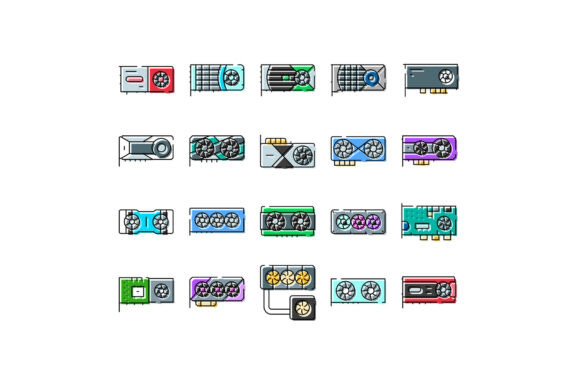
Create a style guide that specifies which icon to use for each GPU category: gaming, professional visualization, compute-focused, and integrated graphics. Define color coding if applicable—for instance, blue for workstation GPUs and red for gaming—but keep it simple. Overcomplicating the system defeats the purpose of visual communication.
Test your icons with real users. Show a set of Computer Graphics Processing Units Icons to a colleague or client and ask them to describe what each icon means to them. If their interpretation matches your intention, the icon works. If not, iterate. This feedback loop is far more valuable than guessing what will be understood.
Finally, think about accessibility. Not everyone perceives color or fine detail in the same way. Ensure your icons are distinguishable by shape and size, not just by color. Add text labels when the context allows, especially in applications where precision matters—such as hardware configuration tools.
Outcomes You Can Expect From Using GPU Icons Thoughtfully
When you integrate a cohesive collection of Computer Graphics Processing Units Icons into your workflows, the benefits become tangible. Documentation gets read faster and understood more completely. Dashboards become scanable at a distance. Marketing materials communicate capability without requiring technical fluency. Cross-team meetings require less back-and-forth clarification because everyone shares the same visual reference.
Over time, the icon set becomes part of your organizational vocabulary. New team members learn the system quickly, and external partners appreciate the clarity. Whether you are building a high-performance computing cluster, designing the next blockbuster game, managing a mining farm, or producing digital art, the right visual representation of your GPU hardware makes your work easier and more effective.
The collection of Computer Graphics Processing Units Icons is not just about having pretty pictures—it is about building a communication framework that supports the complex, fast-paced work you do every day. By choosing icons that align with your users' needs, maintaining consistency across materials, and testing for clarity, you turn a simple set of images into a powerful tool for productivity and understanding.